Wrestling in Iran is not merely a sport; it is part of the historical and cultural memory of society. Its roots lie in ancient rituals, traditions of chivalry, and the mythological narratives of this land. Over generations, it has continued to exist from the dusty fields of rural villages to the large arenas of national competitions. In Iran, wrestling is not only a physical contest but also a shared language among different social classes, a language through which ideas of strength, honor, respect, and collective identity find meaning.
Wrestling competitions are held continuously at different levels: from children’s tournaments, where young athletes gain their first serious experience on the mat, to veterans’ competitions, where the connection to the sport remains unbroken. Men whose championship days are long behind them still return to the mat to preserve the tradition and memory of wrestling. This generational continuity shows that wrestling in Iran is not a temporary phenomenon, but a living and ongoing current.
Alongside official wrestling and national championships, an important part of the identity of this sport lives within Iran’s traditional forms of wrestling, rituals that take place in local arenas, regional festivals, and community gatherings, where the spirit of chivalry still survives in its original form.
In the province of Mazandaran, Loucho wrestling is one of the oldest and most vibrant traditional sporting rituals. The competitions are often held in open village spaces or on earthen grounds where people gather in a large circle. Wrestlers enter the field wearing local clothing, and the competition unfolds in an atmosphere that is at once a celebration, a contest, and a social gathering. In these arenas, the sound of cheering spectators, the presence of village elders, curious children, and men who were once wrestlers themselves all become part of the scene.
In Gilan, Gileh-Mardi wrestling represents another expression of these traditions. The earthen arena, the crowd gathered close around the circle, and the excitement of the spectators created a lively and dynamic atmosphere. In such arenas, the competition is not only between two wrestlers; it also unfolds between memories, traditions, and generations.
In North Khorasan, Choukhe wrestling is practiced with a thick woolen garment known as a choukhe, which plays a role in the technique of the contest. Wrestlers grip each other’s garments to execute their moves, and the matches are often held in open fields on specific days of the year. During these events, people from surrounding towns and villages gather, turning the field into a large communal gathering.
Among the Turkmen communities, Gorash wrestling also holds a special place.
This form of wrestling, practiced with traditional clothing and its own set of rules, is an inseparable part of Turkmen culture. Gorash competitions are held during celebrations and local gatherings, and, like other traditional forms of wrestling, the arena becomes a place to demonstrate strength, skill, and mutual respect.
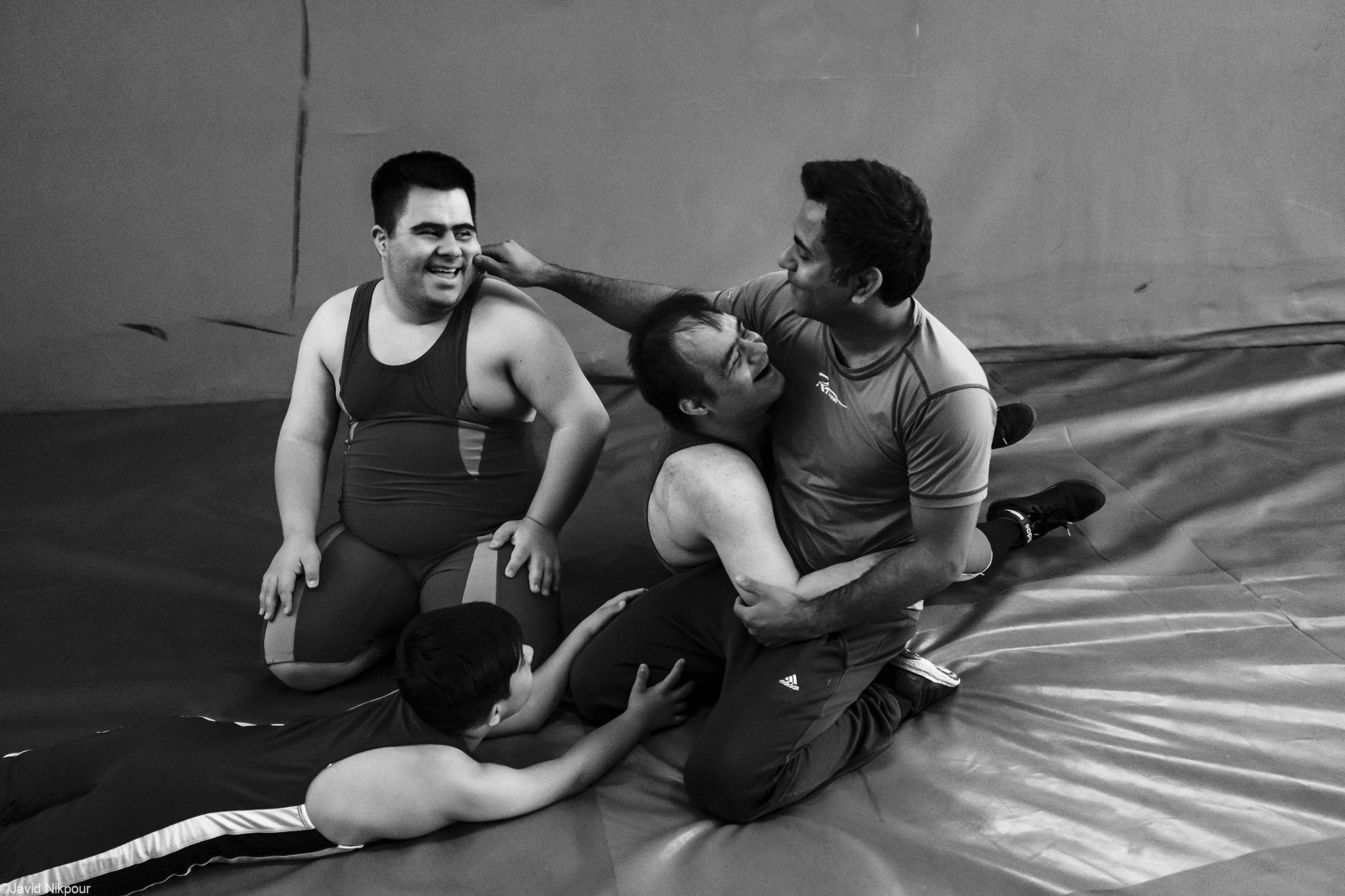
Alongside this wide range of competitions and rituals, wrestling in Iran also carries a human and social dimension that is less often seen. In some clubs, children with Down syndrome take part in wrestling training sessions. Their presence in the training environment is a reminder that wrestling is not only an arena of competition; it is also a space for growth, self-confidence, friendship, and the experience of movement and effort.
Taken together, these different forms of wrestling, from official national competitions to traditional local arenas and everyday training in clubs, demonstrate why wrestling is widely regarded as the “first sport” of Iran. It exists across all levels of society: in modern city arenas, in dusty village fields, in schools, in local clubs, and in community festivals.
This project is an ongoing project that has taken shape over several years and continues to evolve. With each new encounter, new locations, and new human stories, further layers are added to this visual exploration of wrestling in Iran.